Showing posts with label Throwback Thursday. Show all posts

Thursday, 8 August 2013

THROWBACK THURSDAY: Monorail History


One of the most quintessential features of the Disneyland Resort is its groundbreaking monorail system. The monorail itself was first introduced as far back as 1820 in Russia, and didn't find its way to the US until the 1950's. In 1959, the Disneyland ALWEG Monorail System was first constructed. It circled the Disneyland park perpetually, being the first daily-operating monorail in the Western Hemisphere.


The Mark I monorail system was initially a ride, having only one station and two three-car trains. By 1961, it was upgraded to four cars per train and a third train was added. In addition to being able to accommodate more guests, the track was expanded to meet a station at the Disneyland Hotel, and the monorail's primary function became transportation. This was the beginning of the Mark II.

The newly enlarged Tomorrowland Station was extended once again in 1968 to hold four, five-car trains. Known as the Mark III, this was the most drastically changed model to date, as it no longer had an observation bubble, glass windows were added, and the doors were pressurized. After the Mark III monorail, the quantity of cars became five-per-train, and it remains that way to this day. However, four trains appeared to be too many, and the number was shortened back to three in 1988, during the lifespan of the Mark V.

But it seems that the Monorail jumped from Mark III to Mark V. Was there ever a fourth model?

The Mark IV monorail was introduced at Walt Disney World in 1971, and only existed in that park. It held an astonishing 10 trains, half with five cars and the other half with six. It came to Disneyland in the form of the Mark V, a slightly improved Disney World monorail that was German-manufactured. In 1998, the Disneyland Hotel station was demolished, and the Downtown Disney station that stands today, was erected.


The Mark IV/V is perhaps the model that most guests will remember, as it boasted the longest lifespan of any Disneyland monorail. The white chassis and colored stripe were an icon of Disney Park culture, as the design (introduced in 1971) is still employed on the Disney World Mark VI monorail today.

However, in 2008, Disneyland adopted the Mark VII, the most advanced Disney monorail to date. Its sleek design is a throwback to the original Mark I monorail, with likenesses of the red and blue trains that debuted in 1959. It also added a third, orange monorail to the fleet more recently in 2009.


Today's monorails are a far cry from the ones that were introduced in the 1950's. They stand as a testament to both the longstanding technologies that Disneyland pursues with each passing decade, and to the space-age transportation that Walt Disney envisioned to be the defining path to the future.

Thursday, 1 August 2013

THROWBACK THURSDAY: Liberty Street and Edison Square


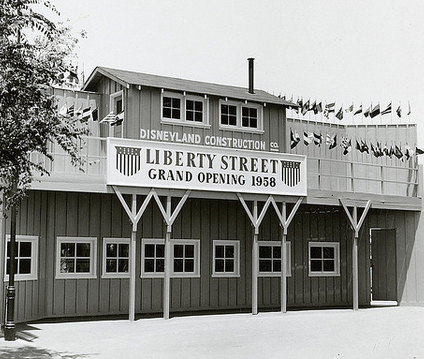
There have been many planned attractions in Disneyland, to never see the light of day. Branching off of Main Street, USA, there were to be several other streets set in-line with the theme of grand, old-fashioned America that was represented by Main Street. Such streets included, Edison Square, Chinatown, International Street, and most notably, Liberty Street.


Liberty Street hearkened back to the days of Colonial America, inspired by New England storefronts and cobblestone streets with a harbor and stationary flagship. Walt Disney's fascination with history and progressive thinking, led him to envision many tributes to the early and pivotal days in America. While Main Street represents the "turn of the century", Liberty Street would showcase the setting for settlers of Rhode Island and Massachusetts, as would have been seen in the 18th century.


Edison Square was a bit like Liberty Street, though based instead on the days of Thomas Edison. Edison was a genius inventor whose practices today wouldn't have been so well-received. He is credited with the invention of the phonograph, the lightbulb, and even movies. Edison Square was not only a tribute, complete with a statue of Edison, but again, an exhibit that replicated the everyday life of Americans as they discovered new technologies like the automobile, and electric lighting.

Guests readied for the grand opening of Liberty Street and others. Signs decorated the closed-off pathways to the future sites. The maps were marked and illustrated with what was to come.


But the years went by, and we still never saw any of these planned attractions. They were left to the imagination.


I believe that if these ideas had come to fruition, Disneyland would have gone in a completely different direction. Rather than having such a focus on Disney franchises and characters, it would have better kept alive the rational Walt Disney dream of creating a timeless universe where visitors can visit different timelines of the past, present, and future. Frontierland would perhaps have become more alive with the spirit of adventure akin to the worlds of Davy Crockett and Tom Sawyer. With Liberty Street, there would be little need for the maritime streets of the much later New Orleans Square, and perhaps the pirate theme would have been a less dominant feature of Frontierland. Whereas today's pirates in Frontierland have all but assimilated the original pioneer and American Indian themes (see Pirate's Lair).

But who knows? All we can do is look back on what could have been. But if they never built Liberty Street and Edison Square, then what took their place?


Perhaps the future isn't so bad after all.

Thursday, 4 July 2013

THROWBACK THURSDAY: PeopleMover and Rocket Rods


The PeopleMover was one of the most famous and iconic transportation rides in Disneyland's rich history. Today, it's one of the most mysterious. Many younger guests who never got to experience the PeopleMover, such as myself, have always been puzzled by the abandoned tracks circling above Autopia and the Submarine Lagoon, and weaving about the many attractions in Tomorrowland. The long-lived attraction was a slow moving transport ride, with many different colorful trains. The PeopleMover eventually took guests inside other rides too, like Space Mountain and Star Tours.


It departed from the still-standing Tomorrowland station and arrived back where it started. The PeopleMover operated at a slow pace, often enticing guests into jumping from car to car. This caused many serious injuries, and even a number of fatalities. In 1995, the PeopleMover closed for good, after a 28-year run.


Although the PeopleMover has been gone for nearly two decades, the tracks and loading station remain intact. Why not use them to create another ride? Well...

They tried.
The Rocket Rods opened in 1998. Advertised for its speed and adrenaline, it was instead famous for excessively long wait-times, and an underwhelmingly short ride experience. Guests would expect to see wait-times of 1-2 hours, and be treated to a ride that lasted three minutes. Keep in mind that the PeopleMover traversed this track in 16, and didn't subject guests to nearly as long a wait. It did however reach a top speed of 35 mph (56 km/h), making it quite a thrill for young riders. The Rocket Rods were loved by many, but hated by most, and were closed after a measly 2 years.

Personally I think the PeopleMover tracks are an eyesore, but couldn't imagine Tomorrowland without them. Disney is known for its lousy job of removing forgotten attractions, mostly because it's an expensive and time-consuming process. But it doesn't explain why this massive set of tracks has been untouched for nearly 15 years. Hopefully, the Imagineers plan to revive the PeopleMover, or maybe even convert them into a large walkway queue. Something to occupy the wasted space sitting above the lands of Tomorrow and Fantasy.

Thursday, 20 June 2013

THROWBACK THURSDAY: TWA Moonliner

Tomorrowland in 1955 left a lot to be desired. It was little more than a set of buildings with semi-futuristic attractions. But it was still iconic and memorable at the time. With such attractions as, seriously, the "Bathroom of the Future". Okay, so it was pretty lame for its first dozen years. The Imagineering team was desperate to complete the park before its opening day deadline, and Tomorrowland relied heavily on corporate sponsorship to fund the costs of construction. One of the new partnerships was with the now-defunct Trans World Airlines, known by most as TWA.

In exchange for helping with Tomorrowland's budget, TWA received a large advertisement in the form of the TWA Moonliner, a retro-looking rocket ship in the heart of Tomorrowland. It was placed directly outside the long-gone attraction that once was, "Rocket to the Moon".


The Moonliner, though stationary and without any real function, occupied space and provided a look at the then new concept of space travel. It was the symbol of Tomorrowland for many years until 1966, when the man behind the project, Howard Hughes, no longer had ties to TWA. For a brief one year period, the TWA Moonliner was sponsored by Douglas Airlines, and received a new paintjob.


It didn't last long though, as in 1967 the park was far too outdated to be considered the "Land of Tomorrow". Sadly, the Moonliner was removed for good. Or perhaps not.

The Moonliner today
In 1998, the Moonliner returned to Disneyland, albeit in a much smaller form. It now sits above the building that was once Rocket to the Moon, but today is Redd Rocket's Pizza Port. The Coca-Cola sign and the caption, "Delivering Refreshments to a Thirsty Galaxy", implies that the rocket is an ad for Coca-Cola, but it is indeed a nod to a once-forgotten relic of historical Tomorrowland.

Thursday, 30 May 2013

THROWBACK THURSDAY: Burning Settler's Cabin

On the banks of the Rivers of America, lie many attractions visible only by the train, the explorer canoes, or the two ferries that circle Tom Sawyer's Island. Each vignette represents what times were supposedly like in the days of pioneers and American Indian tribes. However, one was perhaps a little too realistic.


The Burning Settler's Cabin lay directly across the Rivers of America, as seen from the Disneyland Railroad. It was a moonshiner's cabin set ablaze, apparently by hostile Indians, complete with a dead settler outside. His body was even pierced with an exaggeratedly large arrow, visible to patrons of the train and boat rides. The cabin was one of the more mysterious additions to Frontierland, as it could only be seen from afar, leaving behind many mysteries of origin and explanation. Who was this settler, and why was he attacked by the "Unfriendly Indians"? Well, it's actually a full-body fiberglass cast of former Imagineer Ed Winger. Winger's name can be seen on one of the windows above the Carnation Cafe on Main Street.

Photo from FindingMickey.com
Appropriately, the window is captioned, "Old Settler's Gold Dredging", listing Ed Winger as the proprietor. Now, in 1984, the macabre scenario was altered to be a little more racially sensitive, and the explanation for the fire was that the moonshine still had caught fire. The arrow was removed and the settler was still lying there, presumably asleep after having too much to drink. Around 1991, the flames ceased to burn, and the settler was removed entirely. A hollow, charred cabin stood for many years. Recently however, the entire area has been cleaned up, with many additions such as a fire pit, a stable, and a tree house. A sign in front proclaims that the land is now the home of "Mike Fink: King of the River".

The former Burning Settler's Cabin as it appears today
And what's out in front of Mike Fink's cabin? Oh, just his old racing boat, of course.


Wednesday, 22 May 2013

THROWBACK THURSDAY: Rocket Jets


We've talked about the Rocket Jets before. If you've read that article, you will know that a couple of the rockets from that ride are decorations at the Astro Blasters gift shop. But where exactly was Rocket Jets?

One of the rockets still in Disneyland
Well, Rocket Jets was sort of the predecessor to Tomorrowland's Astro Orbitor. But unlike Astro Orbitor, it wasn't located at the front of Tomorrowland. It was actually located high above Tomorrowland, on top of the PeopleMover station.

Pictured: Two no-longer existent rides
You would board a lift stylized to look like a tower from a real launchpad, walk onto the loading platform and enjoy the ride.

Now, Rocket Jets wasn't the first of its kind. It was not only preceded by Dumbo the Flying Elephant in Fantasyland (1955), but also another very similar and rather short-lived ride in Tomorrowland called the Astro Jets (1956).

Astro Jets, c. 1962
But despite the two other incarnations of a Tomorrowland rocket spinner ride, the Rocket Jets was perhaps the most iconic. Maybe because it resembled NASA's Saturn V rocket at the height of the Space Race, or maybe because it spanned four decades in the park. But one thing can be sure, and it's that the Rocket Jets attraction will be missed. Hopefully the Imagineering department decides to make something of the PeopleMover track, and the large space that was once occupied by the Rocket Jets. Speaking of that space, what's there now?

Oh yes, that um... thing.

Thursday, 16 May 2013

THROWBACK THURSDAY: Motor Boat Cruise

In 1957, Disneyland welcomed a new water ride, the Fantasyland Motor Boat Cruise. Guests could speed around a waterway track in their own motor boat, underneath the tracks of the Monorail, Viewliner, and Junior Autopia.

The steering wheels were non-functioning decorations
The ride was simple and enjoyable, and saw many prosperous years in the park. As the years went by, countless attractions came and went, and it was only fitting that in 1991, Motor Boat Cruise began to come to an end.

Photo from Yesterland.com
In 1991, the Motor Boat Cruise was re-branded as the Motor Boat Cruise to Gummi Glen. In a brief effort to revive the fading motor boat ride, cut-out characters and settings from the NBC cartoon, Disney's Adventures of the Gummi Bears, were placed about the banks of the river to give the ride a theme. Unfortunately, it didn't last, and in 1993 the ride made its final run. However, as the boats may be gone, the waterway lives on, and you can still see some of the banks and turns from the monorail. But perhaps best of all, the loading dock is still 100% intact, and is now used as a rest stop. Though most guests may not recognize or even acknowledge this little awning as any more than a resting place, it was once a queue for a historic ride that will live on in the patrons' memories.

The loading dock today

Thursday, 9 May 2013

THROWBACK THURSDAY: Midget Autopia

Autopia made its debut in Tomorrowland on opening day in 1955. It remains one of the most famous and beloved rides in Disneyland. However, there was once another, smaller speedway that occupied Fantasyland. In 1957, Midget Autopia was born; a child-friendly version of Autopia with non-functioning steering wheels. And it was kids-only.


It existed until 1966, when it was donated to a municipal park in Marceline, Missouri, the place where Walt Disney was raised. The ride was not built to last, and was taken down a few years later. The cars remained in a Disney museum in Marceline, but one was returned to its rightful home: Disneyland.


That car was bronzed and put on permanent display in Tomorrowland, where it sits in front of riders of the current Autopia. Most drivers young and old, will likely ignore this piece of history; unaware that it once gave children their first taste of the road. Still, it's great to be able to enjoy memories of that classic ride some 50 years later.

Thursday, 2 May 2013

THROWBACK THURSDAY: Captain Hook's Galley and Skull Rock


History

Originally known as the "Chicken of the Sea Pirate Ship", Captain Hook's Galley was a restaurant within a pirate ship-- as the name would suggest, a replica of the ship belonging to Captain Hook of the beloved 1953 Disney adaptation of Peter Pan. The galley was permanently situated in a shallow pond in the center of Fantasyland, surrounded on all sides by still-standing attractions such as the Mad Tea Party, King Arthur Carousel, Storybook Land Canal Boats, and Dumbo the Flying Elephant. Due to an initial sponsorship with Chicken of the Sea, the galley served tuna-centered dishes, even after the name was changed.

Original location of the galley
Sometime later, the galley was joined by a faithful recreation of the infamous Skull Rock, to further expand the small, Peter Pan-themed pocket of the park. It stood over the water behind the ship, creating an iconic view that represented Fantasyland for many years. In 1982 when Dumbo and the Carousel were relocated, Captain Hook's Galley and Skull rock were both removed for good.

Captain Hook's Galley and Skull Rock today


The empty spot where the galley once was
Unlike many other former Disneyland attractions, no traces of this old restaurant remain in the park today. However, in Disneyland Paris, you can still visit a Captain Hook's Galley restaurant and Skull Rock, similar to the ones removed from Disneyland long ago. They are appropriately situated somewhat near Pirates of the Caribbean.

The Disneyland Paris version of Skull Rock looks more grim
Here in California however, Disneyland had its own revival of the ship and rock formation. At the Disneyland Hotel's Neverland Pool, a small-scale version of the ship was docked on dry land, beside a Skull Rock water slide. It was a nice nod to the forgotten attraction, but the Neverland Pool too became just a memory, as it was remodeled in 2011 and now contains no references to Peter Pan. Perhaps someday Captain Hook will return to pillage Disneyland, and reclaim his territory in Fantasyland.


Thursday, 25 April 2013

THROWBACK THURSDAY: Golden Rides


For this Throwback Thursday, we're going to go all the way back and revisit the distant year of 2005...
As you may well be aware, Disneyland opened on July 17th, 1955. For Disneyland's 50th anniversary, the park went all out. 50 mouse-shaped signs were scattered about the park to commemorate the 50th anniversary of Disneyland. Special pins, parades, merchandise, anything you can think of received a makeover. Including the rides.


Yes, each of the original "Class of 1955" rides received a special, temporary change-- one of the vehicles (or in the case of the picture above, elephants) was entirely repainted gold. The original 1955 rides that are still operating include King Arthur's Carousel, Autopia, Jungle Cruise, Mr. Toad's Wild Ride, Dumbo the Flying Elephant, Peter Pan's Flight, Storybook Land Canal Boats, and Casey Jr. Circus Train.

See it in the middle?
In fact, not only were the rides changed, but some other 1955 attractions as well. One of the passenger cars on Main Street was painted gold, along with the streetcar seen below.


It made for a fun experience, and gave riders the opportunity of reliving those 50 years of Disney history. Or perhaps getting to ride in all of the golden vessels like a scavenger hunt. Unfortunately, it was only temporary, and by 2006 these golden treasures were returned to their original state, for the most part as they had actually appeared in 1955. But maybe in 2055, on Disneyland's 100th anniversary, we'll get to see something just as special.

Thursday, 11 April 2013

THROWBACK THURSDAY: Ticket Booths

From 1955-1982, Disneyland operated on a ride-ticket system. Though hardly any amusement parks still use this system, they were commonplace at the time. The idea was that guests would pay a relatively small admission fee, and have to buy additional tickets to go on each ride. Attractions were lettered A through E, where an E-ticket could get you on thrill rides like Space Mountain, and an
A-ticket would allow you to ride tamer rides like King Arthur's Carousel.

Tickets were distributed by various ticket booths throughout the park. At these booths, guests could purchase either a ticket book, complete with A, B, C, D, and E-tickets; or individual ride tickets. Today, these ticket booths can still be found in Disneyland, but they no longer sell tickets.


 As you can see, three of these ticket booths are just decorations - only one still functions as a kiosk, providing film and photo information. The mushroom ticket booth in front of Alice and Wonderland seems to have had either its window sealed up, or been replaced entirely. If you go around towards the back of the mushroom there's a door (the corner is just visible in the picture above), hinting that this may perhaps be the original ticket booth. The lighthouse ticket booth, however, appears to be just a replica. I've looked at old photographs of the original ticket booth in front of the Storybook Land Canal Boats, and the position and size of the lighthouse seem to have changed. To my knowledge, at least a couple more disguised ticket booths can still be seen at Disneyland. They won't be easy to find, but it makes for a challenging hunt. Nevertheless, it was a thoughtful decision to leave the ticket booths be, to remind guests of the era of A-tickets and E-tickets.

Thursday, 4 April 2013

THROWBACK THURSDAY: The Slow Decay of the Mine Train

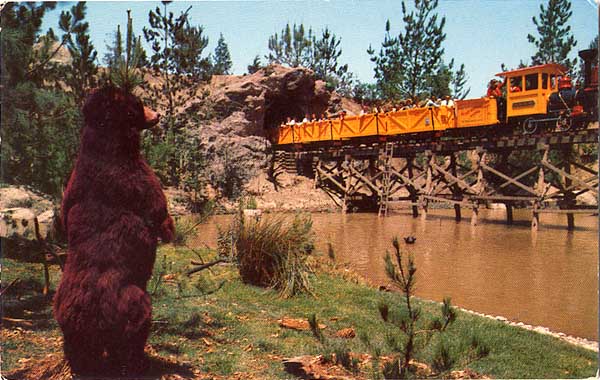
Big Thunder Mountain Railroad is one of the more famous and popular attractions at the Disneyland Resort. As a matter of fact, Disney World, Tokyo Disney, and Disneyland Paris all have their own Thunder Mountain. But only the one in Disneyland can trace its roots back to 1956, when Disneyland was in just its second year. It began as Rainbow Caverns Mine Train, a slow sit-down train that circled around desert rocks and colorful geisers. It didn't offer much, and was classified as a C-ticket attraction. But by 1960, Rainbow Caverns Mine Train was given a major upgrade, and became the Mine Train Through Nature's Wonderland. The new mine train included all sorts of new sites and animals, most notably the new Cascade Peak: a tapering mountain with roaring waterfalls.

Cascade Falls
Nature's Wonderland carried guests all across Frontierland, over ponds and landscapes carefully sculpted by a class of imagineers whose meticulous work can still be seen today. But where?

Well, some parts of the Rainbow Caverns Mine Train are still intact. You may have noticed the Rainbow Caverns on Thunder Mountain, colorful craters inside the cave containing the lift hill. But the real remnant is the loading dock for the mine train. You will briefly pass it by just before exiting the ride.
Familiar?
That's the town of Rainbow Ridge. It served as the queue for both Rainbow Caverns Mine Train and Mine Train Through Nature's Wonderland. But unless you're a Disneyland frequenter, you probably haven't thought much of these old buildings. So let's move on to the more noticeable remains of these old rides.

Bear River back in the day
Many parts of the track are still visible, including multiple tunnels. At one point in the ride, riders traverse a bridge over a bathing ground for bears, and into a cave on the other side of the river. Though the bridge and the bears are long gone, the tunnel can still be seen.


Sadly, these treasures are not permanent, as their state of disrepair causes them to gradually fall apart over the years. After the ride closed, part of the bridge actually remained, but it was destroyed in a storm in 2006.

What the bridge looked like before it collapsed
Remember Cascade Peak? What happened to that? It was huge! Well, that was taken down in the late 1990's, after it had visibly become a cracking pile of decrepit man-made rock and fake trees. What once was a tall mountain with waterfalls had become just a dry mountain, dwarfed by the trees that had grown over the decades. In about 1998, Cascade Peak saw its final days.

Cascade Peak, shortly before its demise
The site of Cascade Peak today
But there's still one last piece of Mine Train Through Nature's Wonderland that we're going to look at. And that's the actual train itself. When the ride was closed, the trains were most likely sent to the Disneyland boneyard, disassembled and recycled. But one of the trains was left on the banks of Rivers of America, where it rotted in front of adventurers on Tom Sawyer's Island and the river's various boat rides. A hauntingly faded and peeling painted reminder, "NWRR" could still be seen on the side of the engine. Animatronic meerkats popped out of what used to be the passenger cars. This change disturbed many guests who hated to see their once favorite ride in such a tragic state. I thought it was awesome. But Disneyland caved in, and removed the train in 2010 to be placed forever in the Disneyland Vault.


Perhaps one day no traces of this historic ride will remain, survived only by these old photographs and stories. But for now, let's celebrate the imaginative ride whose ghosts still haunt the grounds of new Frontierland. Below are images of a couple other vestiges of Nature's Wonderland that you may have noticed. Long live that old west adventure.